planet
plan‧et W3 /ˈplænət, ˈplænɪt/
 noun [countable]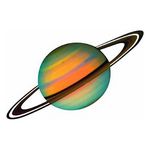
1. a very large round object in space that moves around the Sun or another star:

Mercury is the smallest of all the planets.
Is there life on other planets?
the future of planet Earth
► Do not say ‘in a planet’. Say on a planet.
2. somebody is (living) on another planet/what planet is somebody on? spoken used humorously to say that someone’s ideas are not at all practical or sensible:
He thinks motherhood is glamorous – what planet is he on?
3. the planet the world – used especially when talking about the environment:
a safer future for the planet
—planetary adjective [only before noun]:
the planetary system
■ in the sky
▪star a large ball of burning gas in space, which can be seen at night as a point of light in the sky: The dark night sky was clear and full of stars.
▪planet one of the large objects that goes around the sun, for example the Earth, Saturn, Mercury, or Mars: The planet Uranus was discovered in 1781.
▪sun the star that gives us light and heat, around which the planets move. There are also many millions of other suns in the universe: The sun came out from behind a cloud. | a dying sun
▪moon the round object that moves around the Earth every 28 days, or a similar object that goes around another planet: The moon rose in the night sky. | Titan is one of the moons of Saturn.
▪asteroid a mass of rock that moves around the sun. Most asteroids are found between Jupiter and Mars: the asteroid belt
▪pulsar a type of star that is far away in space and produces radiation and RADIO WAVES
▪quasar an object like a star that is far away in space and shines extremely brightly
▪supernova a very large exploding star
▪constellation a group of stars that forms a particular pattern and has a name: The constellation of Orion is one of the most easily recognizable patterns of stars in the night sky.
▪galaxy one of the large groups of stars that make up the universe: Astronomers have detected a galaxy 11 billion light years away.
▪the universe all space, including all the stars and planets: How many planets in the universe have life?
plan‧et W3 /ˈplænət, ˈplænɪt/
noun [countable] Date: 1100-1200
Language: Old French
Origin: planete, from Late Latin planeta, from Greek planes 'wanderer'
Language: Old French
Origin: planete, from Late Latin planeta, from Greek planes 'wanderer'
1. a very large round object in space that moves around the Sun or another star:
► Do not say ‘in a planet’. Say on a planet.
2. somebody is (living) on another planet/what planet is somebody on? spoken used humorously to say that someone’s ideas are not at all practical or sensible:
3. the planet the world – used especially when talking about the environment:
—planetary adjective [only before noun]:
| THESAURUS |
▪
▪
▪
▪
▪
▪
▪
▪
▪
▪
▪